
Use a wheelchair yourself? Read our guide to flying in a wheelchair.
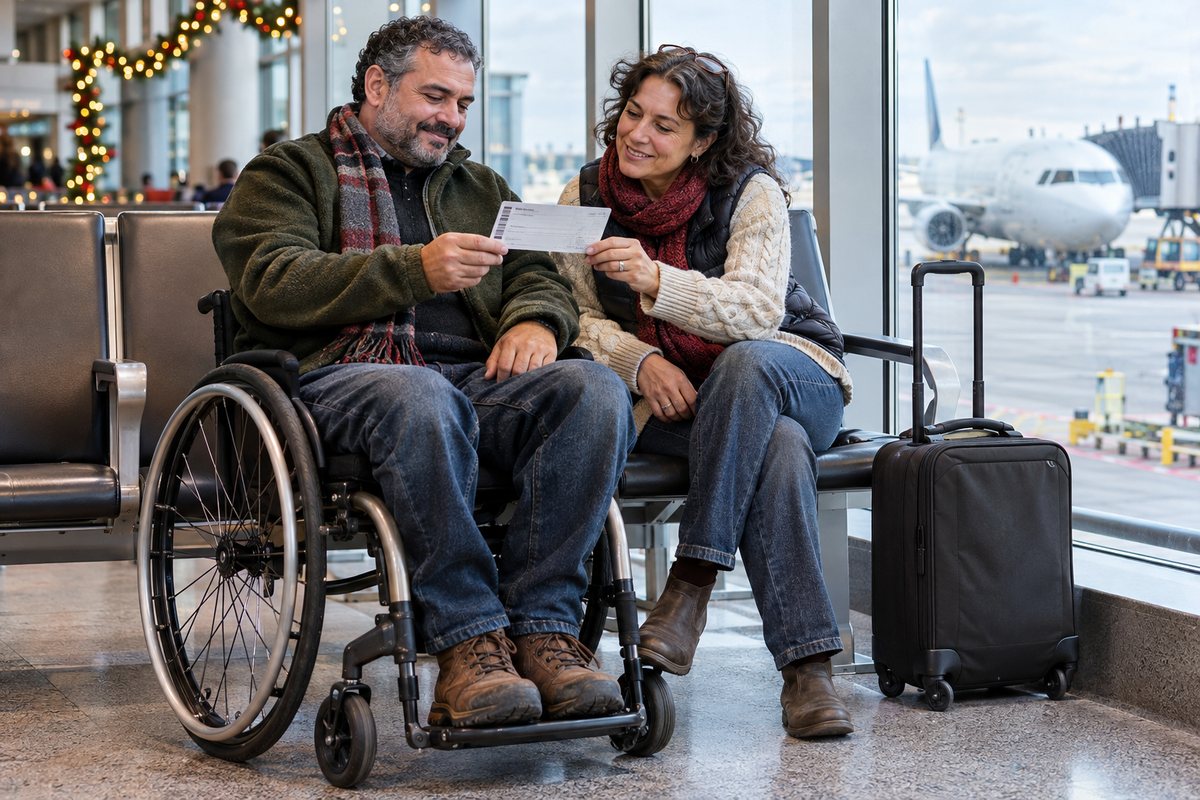
If you're the one who will push the chair, carry the bags and handle the questions at the gate, flying with a wheelchair user over the holidays can feel like a lot. Most of the worry comes down to a short list of what-ifs: What if he needs the bathroom on the plane? What if a bag goes missing? What if security is hard on him? What if they damage his chair?
Every one of those has a plan. This caregiver's guide walks through each worry, one at a time, with steps that take the guesswork out of holiday travel with a wheelchair.

Quick answer: how do you fly with a loved one who uses a wheelchair?
To fly with a wheelchair user, call TSA Cares (855-787-2227) and your airline at least 72 hours before departure. Pack a carry-on with a week of medications and supplies. Plan the traveler’s bathroom and incontinence management routine before departure, considering their mobility, positioning needs, available caregiver assistance, and access to onboard facilities. And know his rights under the Air Carrier Access Act. Everything else in this guide builds on those four steps.
Watch: a real trip through the airport in a wheelchair
We asked our friend Kortlund, who uses a wheelchair, to take us along on a real work trip to Houston with his wife. You'll see them at home, at TSA security, during the transfer to his airplane seat and at the hotel. Watch it first: seeing a couple do it calmly is the best reassurance we know.
Disclosure: QuickChange paid Kortlund to make this video. The experiences and opinions he shares are his own.
Video transcript
At home
Kortlund: Come on a work trip with me to Houston with my lovely wife. This is how I get ready for a quick trip.
This is my grab bar that I put underneath the bed so I can get out of bed easily. This is my raised toilet seat, in order to go number two.
And lastly, this is the most important bag: my carry-on. I put everything I need in here to last a week if all of my other luggage is lost. I have the essentials packed with me. Those being my medications, my catheters, but a great addition is the QuickChange wrap, because I wear that on the plane. It prevents leakage, any type of accident you might have, and it helps bring back your dignity and your independence, 'cause you're always safe.
At the airport
Here we are cruising to get checked in. Medical equipment and devices fly for free.
Here we are on our way to TSA. Most TSA agents are super nice and treat you with respect and dignity.
Boarding the plane
As you can see here, loading the plane now. I'm the first one on and the last one off. Transferring over to the aisle chair here. Getting loaded onto seat 11A while my lovely wife disassembles everything else.
When I'm getting situated, always bring backup. So, two catheters, hand sanitizer and alcohol wipes, in case I need to go to the bathroom in the seat. Other things like chargers, headphones. I'm not able to get up.
Arriving in Houston
And now you'll see my lovely wife assembling my wheelchair, being the last one off, on our way to a medical conference in Houston via the Uber here, and checking in at the Marriott. Thanks for coming with me!
Holiday travel countdown: what to do and when
Anxiety shrinks when you know the next step. Print this checklist or save it to your phone.
Two weeks or more before you fly
- Book or confirm airline wheelchair assistance, and ask for an aisle seat with a movable armrest.
- Ask your hotel or host for photos of the bathroom and bedroom (questions below).
- If he uses a power wheelchair, find the battery type and watt-hour rating on its label.
- Order a QuickChange trial pack so he can test it at home before the trip.
- Refill prescriptions to cover the whole trip plus a few extra days.
At least 72 hours before you fly
- Call TSA Cares at 855-787-2227 and request a Passenger Support Specialist. TSA can't always guarantee one will be assigned, so be ready to explain his needs at the checkpoint. For Thanksgiving 2026 (Thursday, November 26), call by Monday, November 23 for a Thursday flight, or by Sunday, November 22 for the busier Wednesday travel day. TSA Cares is open on weekends.
- Call the airline to confirm wheelchair assistance, the aisle chair and how they'll handle his chair and battery. Ask for it in writing.
The day before
- Pack the carry-on and the "bag is lost" kit (below), and keep them together.
- Call the hotel to confirm the accessible room, and note the name of the person you spoke with.
- Print laminated chair instructions and charge every device.
Travel day
- Arrive early. Holiday lines move slower, and extra time is the cheapest stress relief there is.
- Do his bathroom routine as close to boarding as you can, and put on fresh protection.
- Photograph his wheelchair from every side before it leaves your sight.
Can a wheelchair user use the bathroom on a plane?
Worry #1: "What if he needs the bathroom on the plane?"
Accessing an airplane lavatory can be difficult for someone who uses a wheelchair, and accessible facilities are not guaranteed. Plan their bathroom routine before boarding and choose incontinence protection appropriate for their mobility, positioning, skin-care needs, and available assistance. Changing while seated may be possible for some individuals, but it may not be safe for everyone.
For many caregivers this is the biggest worry of the trip, and the one people are least likely to say out loud. A holiday delay or a long wait on the tarmac can turn a three-hour flight into six. You can take this worry off the table before you leave the house.
How to manage incontinence on a long flight
- Do his routine right before boarding. Not every airport has accessible family restrooms, so it's best to find accessible toilets before the flight. Leave plenty of time to use the toilet, change any incontinence products, and wash up before heading to the gate. If he needs caregiver assistance, check beforehand that the facilities can meet his mobility and personal care needs.
- Don't skip fluids. He shouldn't limit fluid intake or drink much more than usual to manage incontinence. Encourage him to drink as much as he normally would to stay well hydrated. If he has heart or kidney issues or has been told to limit fluids, follow his doctor’s advice.
- Choose protection suited to his individual needs. Changing an incontinence product while seated is not a comfortable option. Choose a product that fits his mobility, positioning needs, skin health, and the level of help he will need from a caregiver. If he needs help with transfers, repositioning, or personal care, arrange it before leaving, and avoid any transfers in tight spaces. Avoid prolonged exposure to moisture to limit the risk of skin irritation.
- Test everything at home first. Test the product at home before boarding to assess fit, leakage, ease of changing, comfort during prolonged sitting, and any signs of skin irritation. Avoid introducing unfamiliar products before a long flight, especially if he has sensitive skin or limited mobility.
- Pack double. Pack enough incontinence supplies to last the whole trip, with extra in case of delays, diversions, or missed connections. It is a good idea to pack spare products, disposal bags, wipes or other cleansing supplies, skin protection products, a discreet change kit, and any essential medication.
Why Kortlund flies with the QuickChange Men's Incontinence Wrap
In the video (a paid partnership with QuickChange), Kortlund wears a QuickChange® wrap for the flight. He says it helps prevent leaks and accidents and lets him keep his dignity and independence in the air.
QuickChange is a men's incontinence wrap designed for men who use wheelchairs or are bed-bound. It fits the seat-based plan above because:
- Designed for convenient changes. QuickChange is designed to allow changes without lifting, transfers, or full undressing. The ease and time required for changing will depend on the individual’s mobility, positioning, and assistance needs.
- It's discreet. It goes on under his clothes, so no one on the plane needs to know.
- May reduce caregiver assistance requirements. Depending on the person’s individual care needs, the wrap may reduce the need for certain lifting or transfer tasks. Caregivers should continue to follow appropriate safe handling techniques whenever assistance is required.
- It's simple to pack. One size, disposable and latex-free.
- It's easy to restock. It's sold at Walmart, CVS and Amazon, so a delay or longer stay won't leave you stuck.
If he uses urinary catheters, he should stick to his usual catheter care routine while traveling, including washing his hands and handling the catheter safely. Pack enough supplies in the carry-on, and check with his clinician on how to use the wrap alongside the catheter.
Try it before you fly: Consider testing the QuickChange wrap at home before traveling to assess fit, comfort, leakage protection, ease of changing, and any signs of skin irritation. This will help determine whether the product is suitable for his needs before a long flight.

What should a wheelchair user pack in a carry-on?
Worry #2: "What if our luggage gets lost?"
Pack the carry-on as if it's the only bag you'll see for a week: medications in their original labeled containers, sufficient medical and incontinence supplies for the entire trip and potential delays, a change of clothes, chargers, and his doctor's contact information. Include any prescribed skin-care products and catheter supplies where needed. Kortlund calls his carry-on his most important bag for exactly this reason.
Holiday travel raises the odds of a delayed bag, and a missing suitcase is far more stressful when his supplies are inside it. Your carry-on checklist:
- Medications in their original labeled bottles, plus a printed list of names and doses
- Sufficient medical supplies for the planned journey, with additional quantities based on individual medical needs and possible travel delays
- QuickChange wraps for the entire trip, and a few extras for possible delays
- A change of clothes for him and a warm layer for a cold cabin
- Phone charger and power bank (power banks must ride in the cabin)
- Your airline confirmation and his doctor's contact information
Pack a "bag is lost" kit inside the carry-on.
Keep a small pouch of absolute essentials you can grab fast, even in a cramped seat:
- Medications and the prescription list
- Catheters or other medical supplies, plus a backup set
- Wipes, hand sanitizer, disposable gloves, and a small trash bag
- Spare QuickChange wraps
- Daily skin-care items, such as barrier cream
If you're carrying his carry-on, never let it get swept into the gate-check pile. Say "medical supplies, this stays with us" and keep it in hand. Medical bags and assistive devices don't count toward carry-on limits.
Does a wheelchair user have to get out of the chair at TSA?
Worry #3: "Will security be hard on him?"
No. A wheelchair user who can't walk through the scanner usually stays seated and gets a pat-down, and TSA officers inspect the chair. He can ask for a private screening at any time. Calling TSA Cares 72 hours ahead lets you request a Passenger Support Specialist, an officer trained to help travelers with disabilities. TSA can't always guarantee one will be assigned, so be ready to explain his needs to the screening officer.
Kortlund says most TSA officers he meets are kind and respectful, and the video shows an officer screening his chair without any trouble.
Call TSA Cares first. TSA Cares is a free helpline for travelers with disabilities, medical conditions and their companions. Call 855-787-2227 at least 72 hours before your flight, or use the online form. Hours are weekdays 8 a.m.–11 p.m. ET and weekends and holidays 9 a.m.–8 p.m. ET.
What to expect at the checkpoint:
- He usually stays in his chair, with a pat-down and a chair inspection.
- Officers may swab his hands or the chair. That's routine.
- He can ask for a private screening, and you can usually be there with him.
- TSA only handles the checkpoint. Pushing his chair through the airport is the airline's job, so request wheelchair assistance when you book.
Tell the officer before the pat-down starts:
- What he can and can't do, such as stand or take a few steps
- Any medical devices, implants, sore spots or areas to avoid
- That he's wearing a protective wrap under his clothes, so no one is surprised
- That his medications and supplies are medically necessary (keep them in a clear bag you can reach)
It's fine to ask the officer to explain each step first. Remove loose items like a seat bag or phone mount from his chair and keep them with you.
How does boarding work for a wheelchair user?
Worry #4: "What about boarding, the transfer and his chair?"
Wheelchair users usually board first and get off last. At the gate, airline staff move him from his own wheelchair to a narrow aisle chair, roll him to his row and help him into his seat. His wheelchair is then gate-checked and stowed below. In the video, Kortlund makes this transfer into seat 11A with his wife beside him.
At the gate
- Check in with the gate agent early. Say he'll pre-board, needs an aisle chair, and how much he can help with the transfer.
- Explain his transfer needs to airline staff, including mobility limitations, areas of pain, suitable transfer techniques, and the level of assistance required. Make sure appropriate assistance and safe handling techniques are used to prevent any risk of injury during transfers.
- Confirm his chair will be gate-checked, and ask how it will be tagged.
- Take the cushion, joystick and any removable parts on board. Tape laminated instructions to the chair for folding, battery shutoff and lifting points.
- Photograph the chair from every side before it goes below.
In his seat
Kortlund keeps backups within reach because he can't get up to fetch anything. His list: two catheters, hand sanitizer, alcohol wipes, a charger and headphones. Put your version in the seat pocket or a small bag at his feet, never in the overhead bin:
- Backup medical supplies and a spare QuickChange wrap
- Wipes, sanitizer, gloves and a small trash bag
- Charger, power bank, headphones, a snack and water
- His medication list and the airline's phone number
During long flights, people with limited mobility or reduced sensation are more likely to develop pressure injuries and skin irritation from sitting for hours and from moisture against the skin. Help the person follow their usual pressure-relief and skin-care routine, including safe repositioning where appropriate.
When you land
Plan to wait while the cabin empties. Ask the crew for updates on his chair, and don't leave the gate area until you've looked it over. Photograph it again and report any damage before you leave the airport.
What are a wheelchair user's rights when flying?
Under the Air Carrier Access Act (ACAA), U.S. airlines must provide free boarding and deplaning help, accept wheelchairs and their batteries, store wheelchairs with priority, and not count them against carry-on limits. These rules cover all U.S. airlines and foreign airlines flying to or from the U.S. According to the U.S. Department of Transportation:
- Wheelchairs and other assistive devices don't count against carry-on limits, and airlines can't charge for accommodations the law requires.
- Wheelchairs get priority storage in the baggage compartment, and a folding chair gets priority for cabin storage if he pre-boards.
- Airlines must accept battery-powered wheelchairs, including the batteries.
- Airlines must provide prompt, safe and dignified help with boarding, deplaning and connections.
- Every airline must have a trained Complaints Resolution Official (CRO) available. If something goes wrong, ask for one by name.
What if the airline damages his wheelchair?
Report it before you leave the airport, with your photos. Airlines are still responsible for repairing or replacing a wheelchair they damage, up to its original purchase price.
A 2024 DOT rule added more protections for wheelchair users, and most of it is in force. However, DOT has paused four parts while it considers changes: the presumption that the airline is at fault for a mishandled chair, how often staff get refresher training, pre-departure notifications and fare-difference refunds. That pause runs until at least December 31, 2026 (Federal Register). Check DOT's disability page before you fly, and keep those photos.
Can you fly with a lithium-battery power wheelchair?
Usually yes, but the rules depend on the battery type (lithium-ion or sealed lead-acid), its watt-hour rating and whether it's removable. Battery questions cause most power-chair trouble at the gate. Before you fly:
- Find the battery type and watt-hour rating on its label.
- Carry the manufacturer's spec sheet and any airline approval letter.
- Ask the airline in writing how it handles his chair and battery. Some airlines remove lithium batteries to ride in the cabin.
- Check the FAA's PackSafe guidance for current limits.
How do you make a hotel or family home wheelchair-friendly?
Worry #5: "Will the hotel or our family's home work for him?"
Ask for photos, not just a yes. Check the bathroom (roll-in shower, toilet height, room to transfer), the bed height and the door widths. If the accommodation is not fully accessible, consider bringing portable equipment, like a raised toilet seat or transfer board. Ensure that it will fit the facilities there and can be used safely in accordance with his mobility and transfer requirements.
Kortlund starts his video at home, not the airport. He shows a grab bar that helps him get out of bed and a raised toilet seat that makes the bathroom work. Small things like these keep him independent at home, and they're exactly what most hotels and relatives' homes lack.
Questions to ask a hotel about wheelchair accessibility
- Bathroom: Roll-in shower or tub? Shower bench? How tall is the toilet, and is there room beside it to transfer?
- Bed: How high is the mattress, and is there room underneath for a lift or his chair?
- Doors and floors: How wide are the bedroom and bathroom doors? Carpet or tile?
For hotels, request the accessible room in writing and get a confirmation number for that request.
Staying with family? A guest bathroom down the hall can be the hardest part of a holiday visit. An incontinence wrap that can be changed while seated or lying in bed may reduce the need for transfers and make personal care more convenient and private during family visits, depending on his mobility, positioning, and assistance requirements.
Plan the ride from the airport
Kortlund and his wife took an Uber to their Marriott. Not every car or driver can handle a wheelchair, so reserve a wheelchair-accessible vehicle ahead of time, or confirm his chair fits the car you plan to use, and have a backup option ready.
Holiday travel tips for caregivers
The best caregiver travel tip is to split the jobs and simplify his routine before you leave, so you aren't running on empty. The video ends on teamwork: Kortlund's wife is there for the transfer, and she puts his wheelchair back together when they land.
- Split the jobs. Decide who handles the bags, who handles the chair and who talks to the airline. If family is meeting you, give them a job too.
- Practice the chair at home. If his chair comes apart, reassemble it a few times before the trip so you're not learning at baggage claim.
- Simplify his routine. Every task that doesn't need lifting or undressing saves your back and your energy. QuickChange was designed with that in mind.
- Ask for help without apologizing. Airline staff, skycaps and TSA Passenger Support Specialists are there to help. That's what they're for.
- Pack essentials for yourself, too. Your medications, a snack and a phone charger. You matter on this trip.
Something will probably go a little sideways: a late flight or a gate change. With a plan, those become small detours instead of emergencies.
Transform your urine management experience and enjoy comfort with QuickChange – try it today with a 10 Count Trial Pack!
Frequently asked questions
Can a wheelchair user use the bathroom on a plane? Usually not easily. Accessing the lavatory may be difficult after boarding, and an accessible lavatory is not guaranteed. Plan bathroom needs before boarding and choose incontinence protection suited to the person’s mobility and assistance needs. Changing while seated may not be suitable for everyone.
How can my husband manage incontinence on a long flight? Do his bathroom routine right before boarding, pack extra supplies and use protection he can change in his seat. The QuickChange men’s incontinence wrap is designed for men with limited mobility and may allow changes without transfers or full undressing. An individual’s mobility and assistance needs determine the ease and time required for changing. Test the product at home before traveling to assess suitability.
Does a wheelchair user have to get out of the chair at TSA? Usually not. If he can't walk through the scanner, expect a pat-down and a chair inspection. He can ask for a private screening at any time.
How far ahead should we call TSA Cares? At least 72 hours before departure, at 855-787-2227. The line is open weekdays 8 a.m.–11 p.m. ET and weekends and holidays 9 a.m.–8 p.m. ET. You can request a Passenger Support Specialist, but TSA can't always guarantee one will be assigned.
Do wheelchairs fly free? Yes, in the U.S. Airlines can't charge for accommodations the Air Carrier Access Act requires, and wheelchairs don't count against carry-on limits. Confirm your airline's handling before you fly.
What happens if an airline damages a wheelchair? Report it before leaving the airport, with photos. Airlines must still repair or replace a chair they damage, up to its original purchase price. Some newer 2024 protections are paused until at least December 31, 2026.
Can I stay with him during boarding and the transfer? Ask the gate agent. Companions often pre-board with the passenger they're assisting, and having you there to explain his transfer can make it smoother.
What should a wheelchair user pack in a carry-on? Medications, medical supplies with a backup set, QuickChange wraps for the entire trip plus a few extras for delays, wipes and sanitizer, chargers, a change of clothes and enough to last several days if checked bags are delayed.
Can he fly with a lithium-battery power wheelchair? Often yes, but it depends on the battery type, its watt-hours and the airline's rules. Know the rating, carry the manufacturer's papers and ask the airline in writing.
How does an aisle chair work on a plane? An aisle chair is a narrow wheelchair that fits down the airplane aisle. Airline staff transfer him from his own chair to the aisle chair at the gate, roll him to his row and help him into his seat.
What should we ask a hotel about wheelchair accessibility? Ask for photos of the bathroom and bedroom, the toilet height, whether there's a roll-in shower, the bed height and the door widths. Request the accessible room in writing.
The trip is worth it
The holidays are about being together, and a wheelchair doesn't have to keep you home. Make the calls early, pack the carry-on like it's the only bag you'll see, know his rights and settle the bathroom question before you leave. Then you can spend the flight holding his hand instead of watching the lavatory door.
Start with the step that takes the biggest worry away. Order a QuickChange 10-count trial pack today, so he has a few weeks to get comfortable with it at home before you travel.
Order the QuickChange trial pack · See how to put on a QuickChange wrap
Safe travels from all of us at QuickChange. We'd love to hear how your trip goes.
Sources
- TSA: Passenger Support and TSA Cares
- U.S. DOT: Passengers with Disabilities
- Federal Register: DOT enforcement discretion on the Wheelchair Rule (Sept. 30, 2025)
- FAA PackSafe
Disclaimer: The information in this article is intended for educational purposes only and should not replace medical advice from a healthcare professional. If you or someone you know is experiencing urinary incontinence, please seek medical help for proper diagnosis and treatment.