Caregiving can involve repeated physical, emotional, and practical responsibilities, whether support is provided at home, in a care facility, or through a professional role. Daily care may include hygiene support, mobility assistance, meals, medication reminders, appointments, and ongoing attention to changes in the person’s needs.
Over time, even routine care can become harder when the caregiver is constantly planning, responding, and staying alert. This guide focuses on support that removes real pressure from the caregiver’s day, including specific help with tasks, clearer routines, emotional support, and ways to reduce the risk of burnout.
How Care Settings Affect Caregiver Support
Caregiving can take different forms depending on who provides support and where care takes place. Informal caregivers are often family members, partners, friends, or other unpaid individuals who assist someone with daily needs. Formal caregivers provide care as part of a professional role in settings such as hospitals, rehabilitation centers, skilled nursing facilities, home care agencies, or hospice programs.
While many care tasks may look similar, the caregiving experience is not always the same. Informal caregivers often balance care responsibilities alongside work, family commitments, and personal obligations. Formal caregivers may provide support to multiple patients or residents while working within clinical procedures, schedules, and care protocols.
Caregiving responsibilities can vary significantly across these roles. The most useful support depends on the caregiver’s role, care setting, and daily responsibilities.
Different Sources of Caregiver Strain
Caregiving can become demanding when daily responsibilities require ongoing attention throughout the day. Support may include mobility assistance, bathing, toileting, incontinence care, meals, cleaning, medication reminders, appointments, communication with healthcare providers, or monitoring changes in a person’s condition. A single task may be manageable, but the repeated nature of care can create physical strain and mental fatigue over time.
The source of that strain can differ for informal and formal caregivers. Informal caregivers may feel pressure because care is tied to family, duty, and emotional attachment. Formal caregivers may feel pressure because care is tied to workload, responsibility, staffing demands, and repeated exposure to patient or resident needs. The table below shows how caregiver strain can appear differently depending on the role.
|
Area of Strain |
Informal Caregivers |
Formal Caregivers |
|
Emotional pressure |
May experience guilt connected to family responsibility. |
May experience emotional fatigue after supporting many patients, residents, or clients over time. |
|
Separation from care |
Often struggle to separate caregiving from personal life. |
Often struggle to recover from workload and shift demands. |
|
Isolation or overload |
May feel isolated when most care tasks and decisions fall on them alone. |
May feel overwhelmed by staffing pressure and competing priorities. |
|
Sense of responsibility |
Can feel responsible for every outcome affecting a loved one. |
Can feel responsible for multiple patients, residents, or clients. |
|
Burnout pattern |
Burnout often develops when emotional attachment is combined with constant availability and limited backup. |
Burnout often develops when heavy workloads, time pressure, and repeated care demands continue across shifts. |
When strain builds from several directions, general encouragement is rarely enough. The next step is identifying what kind of support caregivers need most.
Support Needs in Different Caregiving Situations
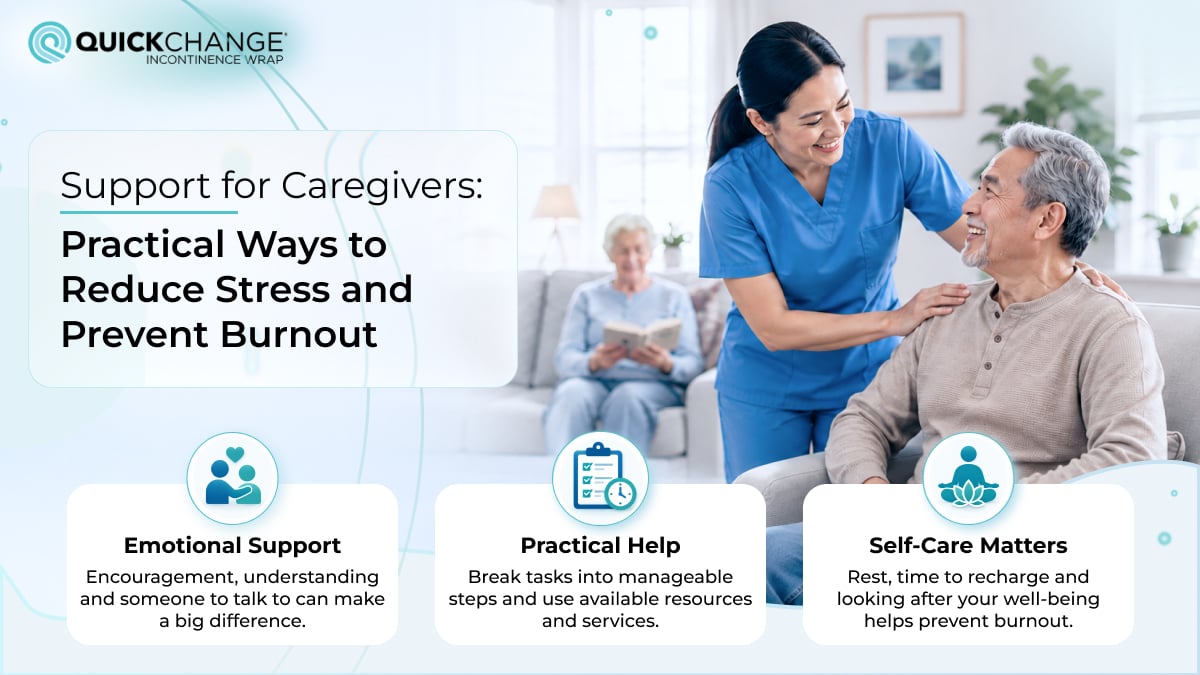
Caregiver support usually needs to address several parts of the role. In most cases, what they need most is a combination of practical help, emotional support, time to rest, clear communication, predictable routines, and a support system they can rely on.
These needs are not only emotional. The report from AARP and the National Alliance for Caregiving found that one in five caregivers reports poor health, and seven in ten family caregivers are also employed. When caregiving overlaps with work, health needs, and daily responsibilities, support has to reduce actual workload rather than simply encourage the caregiver to cope. In practice, the most useful support usually falls into several areas:
- Practical help
For informal caregivers, practical help may mean fewer home responsibilities falling on the same person. For formal caregivers, it may mean safer workflows, organized supplies, adequate staffing, or tools that reduce unnecessary steps during repeated care tasks.
- Emotional support
Informal caregivers may need room to speak honestly about guilt, stress, frustration, or fatigue without judgment. Formal caregivers may need support after emotionally demanding shifts, repeated exposure to patient needs, or workplace stress.
- Time for rest
For informal caregivers, rest may require someone to step in for a specific period of time. For formal caregivers, recovery may depend on realistic workloads, scheduled breaks, and enough time between demanding shifts.
- Clear communication
Informal caregivers often need clear communication with family members, healthcare providers, and the person receiving care. Formal caregivers need clear handoffs, care instructions, documentation, and communication within the care team.
- Predictable routines
A basic structure can reduce daily confusion for both groups. At home, this may involve organizing care tasks and supplies. In professional settings, predictable routines can support consistency across shifts, residents, or patients.
- Support systems
Caregiver support should not depend on a single person or a single resource. Informal caregivers may rely on family help, respite care, professional guidance, and community resources. Formal caregivers may rely on supervisors, care teams, training, staffing support, and workplace protocols. Access Care Partners notes that family caregiver support may include education, support groups, respite options, and guidance, which makes outside resources an important part of long-term support.
Why Caregiver Stress is Not Always Visible
Emotional strain is not always easy to recognize. A caregiver may appear calm, organized, and fully in control while still feeling tired, tense, or emotionally drained. They may continue to manage appointments, care routines, medications, hygiene support, documentation, or family communication, even when the role has started to affect their own well-being.
Because the focus is usually on the person receiving care, the caregiver’s emotional state can receive less attention. Stress, guilt, frustration, anxiety, or fatigue may build gradually when there is little space to speak honestly about the demands of the role. Emotional support helps make that strain easier to acknowledge before it becomes something the caregiver carries alone.
Healthy emotional support does not always require a long conversation or professional counseling. It begins with listening without judgment, regular check-ins, and creating space for honest communication. Family caregivers may benefit from feeling heard by relatives, friends, or healthcare professionals. Professional caregivers may benefit from supportive colleagues, supervisors, or workplace environments where concerns can be discussed openly. Support can be as simple as:
- “That sounds like a lot to carry.”
- “Do you want advice, or do you just need me to listen?”
- “What would make this week easier?”
Supportive phrases do not solve every problem, but they can help the caregiver feel noticed and respected.
How to Support a Caregiver in Daily Life
Daily support is most useful when it removes a specific task rather than adding another decision. “Let me know if you need anything” may be well-intentioned, but many caregivers are already managing too many choices, schedules, and responsibilities.
A clearer offer is easier to accept: “I can pick up prescriptions on Tuesday,” “I can cover the appointment,” or “I can bring dinner on Friday.” Useful help removes a task the caregiver would otherwise have to plan, remember, and complete alone.
Practical Ways to Support Informal Caregivers
Informal caregivers often need help that removes specific tasks from the day rather than adding more decisions. The most useful support is usually practical, scheduled, and easy to accept.
1. Assist with Daily Activities
Everyday chores may seem small, but they often take the energy a caregiver no longer has at the end of the day. Meals, laundry, cleaning, dishes, taking out the trash, pet care, or simple tidying can reduce the pressure around home care.
2. Provide a Reliable Short Break
Even 1-2 hours of relief can be valuable if the caregiver can actually count on it. Instead of saying, “Maybe I’ll stop by sometime,” offer a specific time and keep the commitment. A planned break can give the caregiver time to rest, eat, leave the house, or simply be alone without waiting for the next care need.
3. Help with Groceries or Transportation
Grocery shopping, pharmacy trips, appointment transportation, or other errands can reduce both physical effort and planning. For an informal caregiver, leaving the house may not be simple if the person receiving care cannot be left alone or if every trip requires preparation.
4. Attend Appointments or Help Take Notes
Medical appointments often involve recommendations, medication changes, next steps, restrictions, or symptoms to monitor. Another person can help listen, ask clarifying questions, and write down important details, which reduces the pressure on the caregiver who is already managing much of the care.
5. Check in Regularly
Regular check-ins should focus on the caregiver, too, not only the person receiving care. Instead of only asking, “How is he?” or “How is she?”, try asking, “How are you doing?” A thoughtful question can help the caregiver feel seen rather than overlooked.

Practical Ways to Support Professional Caregivers
In professional care settings, support often depends on clear information, organized workflows, safe handling practices, and realistic expectations during repeated care tasks.
1. Share Relevant Care Information
Clear information about symptoms, mobility limits, routines, medications, preferences, or recent changes can help care teams respond more effectively. When important details are missing, caregivers may need to spend extra time clarifying needs or making decisions during care.
2. Keep Supplies and Care Areas Organized
Repeated care tasks become harder when essential supplies are missing, scattered, or difficult to access. Organizing gloves, wipes, linens, incontinence supplies, disposal bags, and other routine items can reduce unnecessary interruptions during a shift.
3. Support Safe Physical Care
Personal care often involves lifting, repositioning, transfers, hygiene assistance, or repeated movement. Safe equipment, enough help for physically demanding tasks, and realistic expectations around patient handling can help reduce strain and lower the risk of injury.
4. Make Workloads More Realistic
Care quality is harder to maintain when one caregiver is expected to manage too many tasks at once. Clear task assignments, adequate staffing, and support from supervisors or the wider care team can make repeated responsibilities more manageable during a shift.
5. Recognize Emotional Strain
Training does not remove the emotional weight of care. Difficult conversations, patient decline, family concerns, and repeated exposure to illness or dependency can affect caregivers over time. Support from supervisors, colleagues, and care teams can help reduce the feeling that each caregiver has to manage the workload alone.
Even with practical help, caregiving can still create ongoing stress. Recognizing stress early can prevent it from becoming harder to manage.
Caregiving Tips for Making Daily Routines Easier
Routines are most useful when they remove small repeated problems from the day: searching for supplies, deciding what to do next, moving the person more than necessary, or stopping mid-task because something is missing. A routine does not make caregiving predictable, but it can make repeated care tasks easier to start, complete, and adjust when needs change. A useful routine gives the caregiver structure without making the day rigid.
- Set one fixed relief window
Instead of waiting for a free moment, arrange one specific block when another person takes over a task, appointment, or part of the routine.
- Reduce avoidable night interruptions
Prepare supplies before bedtime, move non-urgent tasks to daytime, and share night duties when possible.
- Choose one delayed health task
This may be a prescription refill, overdue appointment, screening, or symptom the caregiver has been ignoring.
- Track recurring care patterns
A meal, grocery run, appointment ride, laundry load, or short coverage period is easier for others to act on.
- Lower the standard for non-essential tasks
Not every chore needs to be done the same day. The priority should be safety, hygiene, medication, nutrition, and rest where possible.
- Use outside support before burnout becomes severe
Support groups, respite options, healthcare providers, social workers, or community resources can help when the current routine is no longer sustainable.
When Daily Care Includes Male Urinary Incontinence
Not every caregiving routine includes incontinence care. When male urinary incontinence is part of daily support, repeated changes can become one of the more physically demanding parts of the routine. The challenge is not only the product change itself, but also positioning, clothing adjustments, cleanup, privacy, and the need to avoid unnecessary movement when the person receiving care has limited mobility.
Solutions such as QuickChange Wraps can help simplify certain male urinary incontinence changes by supporting top-down replacement during daily care routines. This can be especially useful when caregivers need to reduce unnecessary repositioning or avoid turning each change into a full clothing adjustment.
For home caregivers, a trial pack can be a practical way to see whether QuickChange Wraps fits the person’s needs, mobility level, and daily routine. For professional care teams, sample options can support evaluation in real workflows, including staffing routines, mobility support, and incontinence care needs.
Easier routines can reduce daily pressure, but sometimes a caregiver is already past the point of simple stress. When exhaustion has started to affect daily life, burnout needs to be addressed more directly.
Caregiver Stress Management: Recognizing the Warning Signs
Caregiver stress often builds gradually. What begins as ordinary fatigue after a difficult day can turn into constant tension that does not improve with short rest. This is especially difficult when everyone around expects the caregiver to “handle it” because they continue to perform daily tasks, organize care, and keep the situation under control.
Caregiver stress management doesn’t start with a perfect self-care routine, but with the ability to recognize warning signs. If you notice these signs early on, it’s easier to adjust part of your routine, ask for specific help, or take a short break before stress becomes part of the caregiver’s daily routine. Managing caregiver stress is important not only for the caregiver themselves but also for the quality of care, because chronic stress can affect patience, concentration, sleep, and the ability to respond calmly to daily care tasks. Signs of caregiver stress may include:
- Trouble sleeping or waking up tired;
- Irritability or sudden anger;
- Constant fatigue;
- Feeling emotionally drained;
- Losing interest in personal activities;
- Guilt when taking time for yourself;
- Withdrawing from friends or family;
- Headaches, muscle tension, or stomach discomfort;
- Feeling impatient during routine care tasks.
When these signs become a regular pattern, stress is no longer just a response to one difficult day. At that point, the caregiver may need a change in routine, clearer help from others, or a real break. Addressing these signs early can help prevent caregiver burnout before the caregiver reaches a breaking point.
How to Prevent Caregiver Burnout
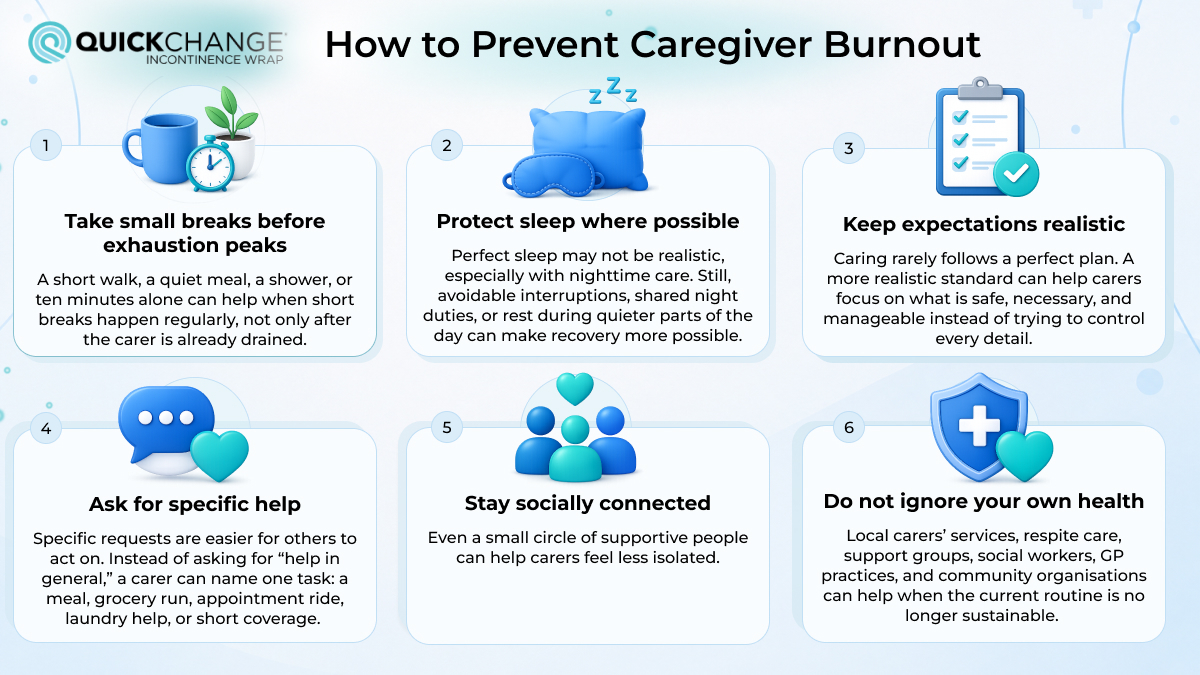
Preventing caregiver burnout is not about becoming stronger while the same pressure continues. It is about making the caregiving role more realistic before exhaustion becomes the caregiver’s normal state. Learning how to avoid caregiver burnout often starts with small, repeatable changes that protect the caregiver’s time, health, and energy. Caregiver self-care works best when it is realistic enough to fit into daily life. Small changes may include:
- Take small breaks before exhaustion peaks
A short walk, a quiet meal, a shower, or ten minutes alone can help when short breaks happen regularly, not only after the caregiver is already drained.
- Protect sleep where possible
Perfect sleep may not be realistic, especially with nighttime care. Still, avoidable interruptions, shared night duties, or rest during quieter parts of the day can make recovery more possible.
- Keep expectations realistic
Caregiving rarely follows a perfect plan. A more realistic standard can help caregivers focus on what is safe, necessary, and manageable instead of trying to control every detail.
- Ask for specific help
Specific requests are easier for others to act on. Instead of asking for “help in general,” a caregiver can name one task: a meal, grocery run, appointment ride, laundry help, or short coverage.
- Stay socially connected
Even a small circle of supportive people can help caregiving feel less isolating.
- Do not ignore your own health
The National Institute on Aging advises caregivers to make time for their own health, including eating well, staying active, prioritizing sleep, and seeking support when caregiving feels overwhelming.
How to Cope With Caregiver Burnout
Coping with caregiver burnout starts with recognizing that burnout is not a personal failure. It usually develops when a caregiver carries too much responsibility for too long without enough support, rest, or recovery. At this stage, the person may feel exhausted, overwhelmed, emotionally drained, or unable to return to a normal level of energy even after short breaks.
Dealing with caregiver burnout usually requires reducing the load, not simply asking the caregiver to become more resilient. If the same person continues to manage every care task, appointment, emergency, household responsibility, and emotional need alone, burnout will likely keep getting worse. This is the point where support needs to become more direct: family members may need to take over specific tasks, respite care may need to be considered, and professional guidance from a healthcare provider, counselor, or social worker may be helpful. If burnout is already affecting daily life, practical next steps may include:
- Telling a trusted person clearly that help is needed;
- Identifying which tasks can be shared immediately;
- Arranging respite or temporary support if available;
- Speaking with a healthcare provider, counselor, or social worker;
- Joining a caregiver support group;
- Simplifying the most physically demanding routines;
- Seeking urgent help if stress feels unsafe or unmanageable.
A caregiver support group can be useful when burnout is made worse by isolation or the feeling that no one else understands the role. These groups may be available online, through healthcare providers, local organizations, disease-specific charities, or caregiver networks. They can give caregivers a place to ask practical questions, compare care routines, learn about respite options or local services, and talk with people facing similar responsibilities. Support groups do not replace medical or mental health care, but they can make it easier to take the next step instead of carrying the situation alone.

Conclusion
Caregiving becomes harder to sustain when one person is expected to manage daily tasks, emotional pressure, and practical decisions with too little support. The most useful help reduces that load instead of adding more advice or expectations. Listening without judgment, helping in specific ways, recognizing stress early, and making routines easier can all support the caregiver’s well-being over time.
For caregivers who manage male urinary incontinence, support can also mean reducing the physical effort involved in repeated changes. When daily care includes repositioning, clothing adjustments, or frequent hygiene routines, solutions such as QuickChange may help simplify certain changes and make the process easier to manage. With practical help, emotional support, realistic routines, and the right care supplies, caregivers are better able to protect their own well-being while continuing to provide care.
Frequently Asked Questions
Where can caregivers find support outside their family?
Caregivers can look for support through local community organizations, healthcare providers, disease-specific charities, respite care programs, faith-based groups, or online caregiver communities. The best option often depends on the care situation. For example, a caregiver supporting someone after a stroke may need different resources than a caregiver helping an older adult with dementia, mobility loss, or urinary incontinence.
Can caregiver support groups really help?
Caregiver support groups can be useful when stress is worsened by isolation or by the feeling that no one else understands the role. They give caregivers a place to ask questions, compare practical routines, learn about local resources, and talk openly with people in similar situations. A support group does not replace medical or mental health care, but it can make the role feel less isolating.
How can family members share caregiving responsibilities more fairly?
A written task list can help. Instead of saying one person “helps when they can,” families can divide specific responsibilities, such as grocery shopping, transportation to appointments, medication pickup, laundry, meal preparation, bill management, or short coverage periods. Clear tasks are easier to track and less likely to fall back on the same caregiver every time.
What should you say to a caregiver who keeps saying they are fine?
It can help to avoid pushing for a dramatic answer. Instead, ask about one practical part of the week: “What task has been hardest lately?” or “Is there one thing I can take off your plate this weekend?” Some caregivers say they are fine because they do not want to explain the whole situation, so specific, low-pressure offers are often easier to accept.
When should caregiver stress be discussed with a healthcare professional?
Caregiver stress should be discussed with a qualified professional when exhaustion affects sleep, mood, concentration, physical health, or the ability to provide care safely. It is also important to seek help if the caregiver feels unable to cope, becomes increasingly isolated, or feels overwhelmed by anxiety, anger, or sadness. Support may come from a physician, counselor, social worker, or care coordinator.
How can you support a caregiver from a distance?
Long-distance support can still be practical. Family members can schedule appointments, order supplies, manage paperwork, arrange grocery delivery, coordinate transportation, research respite options, or set up regular check-ins. The goal is to remove planning and administrative tasks, not only to ask for updates.
This content is for informational purposes only and is not intended as a substitute for professional medical advice, diagnosis, or treatment. Always seek the advice of your GP or other qualified health provider with any questions you may have regarding a medical condition. Never disregard professional medical advice or delay seeking it because of something you have read or seen here.