For families and caregivers
What is CAUTI?
CAUTI stands for catheter-associated urinary tract infection. It’s a bladder or kidney infection that’s linked to having a urinary catheter.
A catheter is a thin tube that drains urine from the bladder into a bag. Hospitals and care facilities use them for lots of reasons. The CDC says catheters are linked to about three out of four urinary tract infections that people pick up in the hospital (CDC).

Why does it come up so often?
According to the CDC, the longer a catheter stays in, the more the risk goes up (CDC). That’s why care teams check regularly whether someone still needs one.
What should I watch for?
If your loved one has a catheter and you notice a fever, chills, new confusion, or pain in the belly or back, call their doctor or nurse right away.
Questions to ask the care team
You don’t need medical training to be a good advocate. These questions are a great place to start:
-
Why does my loved one need a catheter?
-
How long will it stay in?
-
Are there options that don’t go inside the body?
-
What should I keep an eye on at home?
The CDC also encourages patients and families to ask, regularly, whether the catheter is still needed (CDC). 
Where QuickChange fits
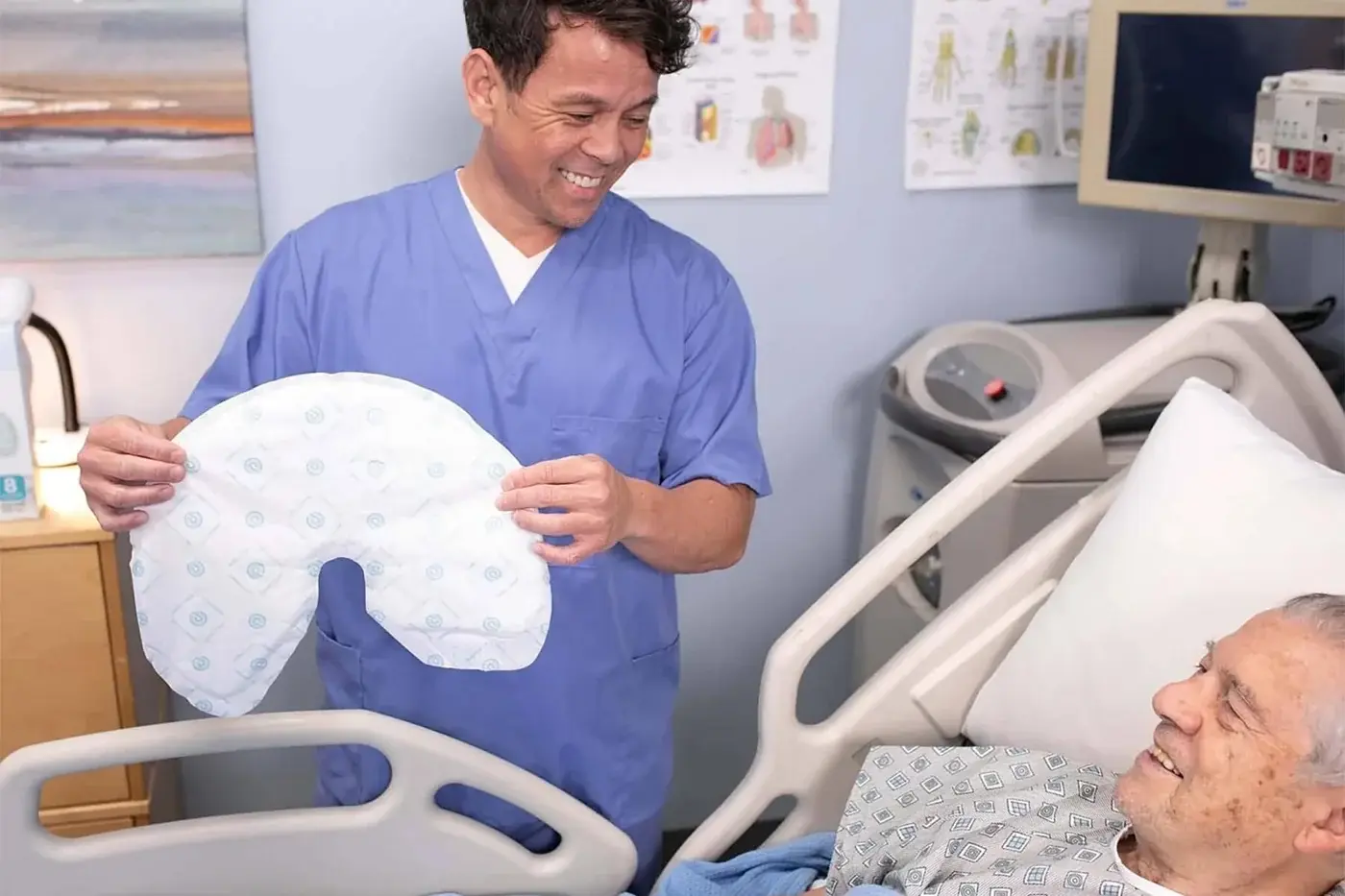
QuickChange isn’t a catheter. It’s a soft wrap that goes around the penis and soaks up urine, so nothing goes inside the body. It holds up to 500 cc (17 oz), and one person can change it in under 60 seconds without lifting or rolling.
It’s made for men who are in bed or use a wheelchair, and for nighttime use. It can also be used along with an external catheter as a backup. If your loved one doesn’t need a catheter for medical reasons, ask the care team if QuickChange could be an option. Try a 10-pack to see how it works.
For nurses and care facilities
The CDC’s CAUTI guidance centers on a few core practices. We link to them here so your team can go straight to the source (CDC Clinical Safety):
-
Use urinary catheters only when needed
-
Insert with sterile technique and sterile equipment
-
Keep the closed drainage system sterile
-
Remove catheters as soon as they’re no longer needed
The CDC also points facilities to the 2009 CAUTI prevention guideline, the 2022 acute care update, NHSN tracking and its TAP Strategy. Always follow your facility’s own protocols.
How QuickChange can help your team: more than 1,000 facilities across the US use QuickChange. It’s a one-size, latex-free wrap that holds up to 500 cc (17 oz). Staff can change it in under 60 seconds, with no lifting or rolling, for bed-bound and wheelchair-using men. Request a professional sample or inservicing, or see our Clinical Studies.

FAQ
What does CAUTI stand for?
Catheter-associated urinary tract infection. It’s a urinary tract infection linked to having a urinary catheter.
Is a catheter always needed?
Not always. Only a doctor can decide. It’s okay to ask the care team why one is being used and whether other options might work.
What are the signs of CAUTI?
Fever, chills, new confusion, or belly or back pain can be signs. Call the doctor or nurse right away if you notice any of them.
Is QuickChange a catheter?
No. QuickChange is a wrap that goes on the outside of the body and soaks up urine.
Where can facilities find CAUTI guidance?
The CDC’s CAUTI clinical safety page links to the full guidelines.
This article is for general information only and isn’t medical advice. Talk to a doctor or nurse about any health concerns.
Sources:
CDC https://www.cdc.gov/hai/ca_uti/uti.html
Healthline https://www.healthline.com/health/catheter-associated-uti
Nursing E Journal https://nursing.ceconnection.com/ovidfiles/00004045-201207000-00006.pdf