Patients receiving end-of-life care due to terminal illnesses or conditions are faced with progressive physical decline, which gradually weakens or completely disables some of the body's functions. Urinary incontinence is no exception to this loss of function, which is a common and often underestimated problem among end-of-life patients.
Underestimating urinary incontinence significantly affects comfort, dignity, skin integrity, and overall quality of life, all of which should not be neglected in end-of-life care. This is where death doulas, professionals who provide advocacy, coordination, and emotional support, can help. In this article, learn more about the role of death doulas in patient support and their role in influencing the quality of care, including incontinence management.
What is a Death Doula?
A death doula, also known as an end-of-life doula, is a qualified non-medical professional who provides holistic emotional, spiritual, and practical support to people at the end of their lives and their families. They focus on compassion, offering companionship, assistance with last wishes, and help with inheritance planning. Key characteristics of an end-of-life doula:
- Not providing medical, diagnostic, or clinical treatment.
- Supporting not only patients but also their relatives and caregivers, providing them with respite.
- Providing quality emotional support, helping to overcome fears, and ensuring peace of mind.
- Advise families on what to expect and what to do after the death of a family member.
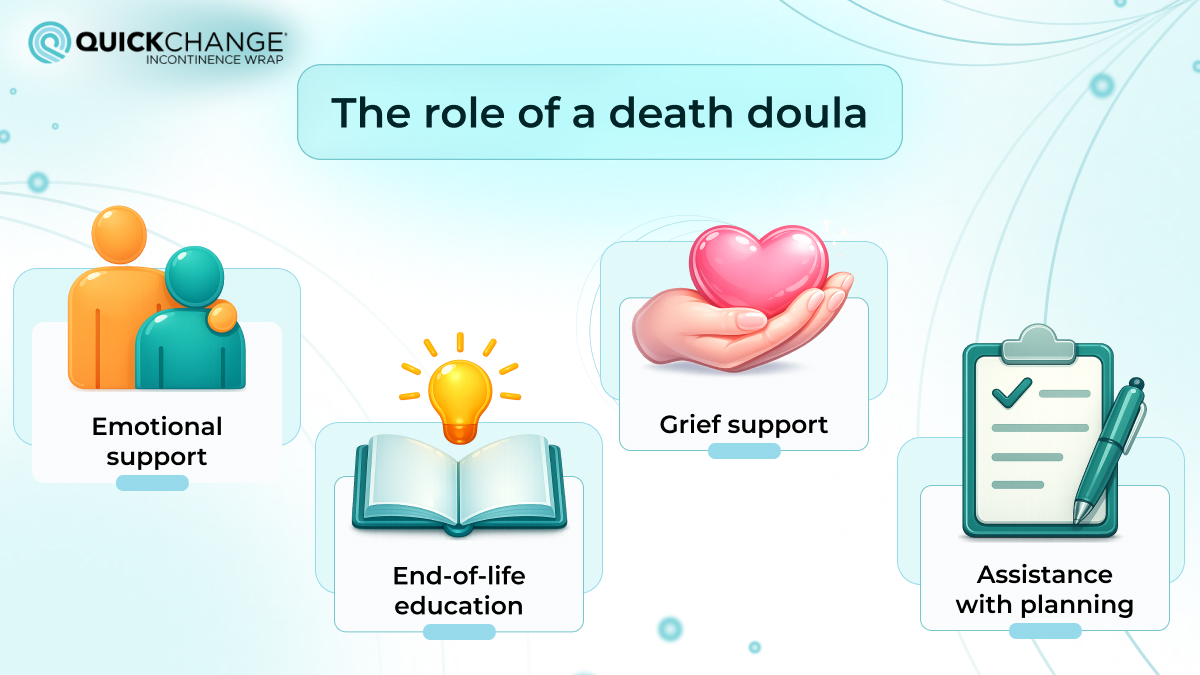 The main goal is a peaceful, supported, and dignified end of life for the person. The death doulas meaning is rooted in continuity and presence. Much like birth doulas support families through childbirth, end-of-life doulas support people through the final stage of life.
What Does a Death Doula Do in Practice?
The specifics of death doula work vary considerably depending on training and conditions, but there are general responsibilities that we can identify. The death doula job description fits within the framework defined by professional organizations such as the International End-of-Life Doula Association (INELDA), which emphasizes non-medical, patient-centered support as the basis of end-of-life doula services. Regardless of the conditions, the main tasks of death doulas are:
- Combining emotional, informational, and advocacy support,
- Encouraging conversations about fears and helping to alleviate them,
- Discussing and fulfilling end-of-life wishes,
- Supporting advance care planning,
- Helping families understand the end-of-life process,
- Providing practical advice on daily comfort and routines,
- Monitoring the impact of symptoms on daily life.
End-of-Life Doula Care in the USA
In recent years, care for the terminally ill in the United States has shifted its focus from primarily clinical outcomes to comfort, dignity, and individualized care. Although hospices and palliative medicine remain central elements of the patient support process, families are additionally turning to non-medical forms of support to address the emotional, practical, and interpersonal aspects of end-of-life care. In this context, the role of the death doula, also known as a hospice doula, is gaining increasing recognition.
Understanding what a death doula is, what a death doula does, and how this role intersects with daily comfort measures, such as UI management, provides important insights into how to improve person-centered end-of-life care in the United States.
Death Doula vs. Hospice Care: Explaining Differences and Similarities
In the US, death doulas work alongside hospice services, not instead of them. This is important to note because they are often perceived as interchangeable services, and people search the internet for comparisons between death doulas and hospice care. However, there is a clear difference between these types of care, and pointing it out will help to better understand the distinction and some specific details, such as the nature of the support, the services provided, and their coverage.
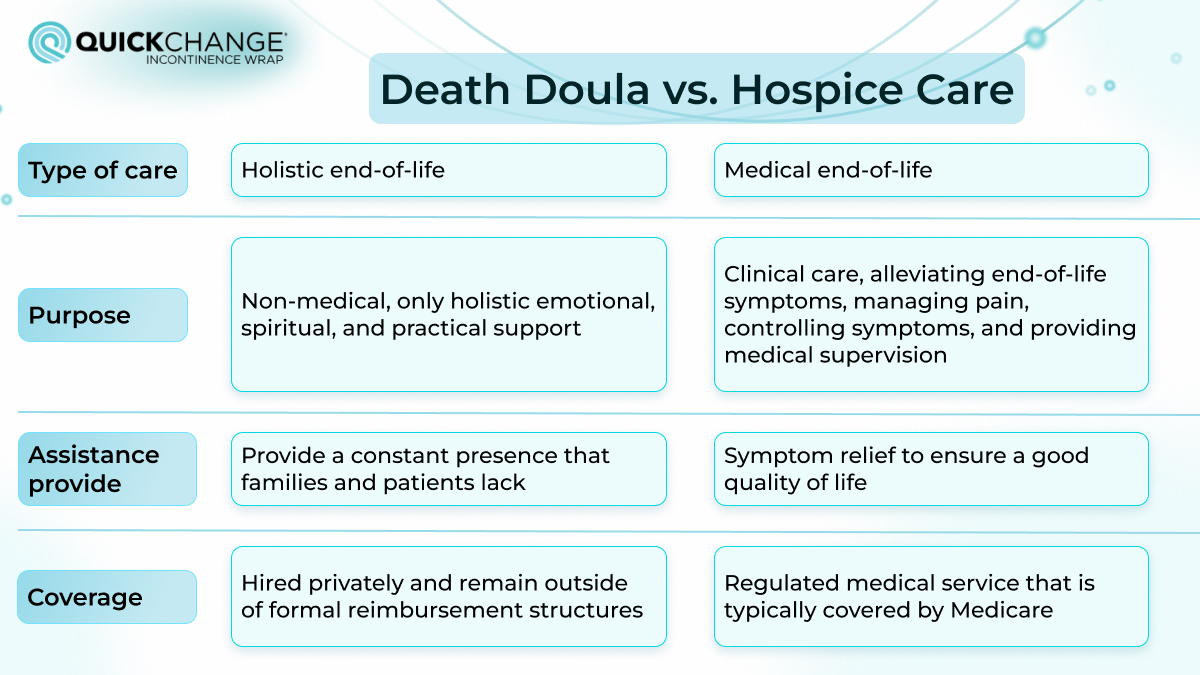
Please note! Coverage of medical services is usually what patients or their families are most concerned about when applying for hospice care. Hospice care is covered by Medicare as a regulated medical service, but death doulas do not fall within formal reimbursement structures and are paid and hired privately.
Death Doula Role in Managing Urinary Incontinence
In this article, we want to focus on some symptoms that are common in terminal illnesses, primarily urinary incontinence (UI). This symptom is common among terminal patients, especially elderly men, affecting not only their comfort and skin integrity but also causing a significant load on caregivers. As confirmed by the National Institute on Aging (NIA), bladder control problems are common among older adults with chronic diseases, neurological disorders, and limited mobility, factors that are often encountered at nursing homes and in terminal care.
Since urinary incontinence rarely occurs as an isolated condition at the terminal stages of life, its onset and worsening reflect disease progression, neuromuscular decline, cognitive impairment, and multiple organ failure. From a prognostic standpoint, UI is also recognized as a marker of disease severity. A large systematic review and meta-analysis published in BMJ Open reported that the onset of urinary incontinence is often associated with an increased risk of mortality, with the risk increasing along with the severity of incontinence.
In caring for the UI, death doulas play an important role in supporting the patient's emotional state and dignity, as well as monitoring the quality of care and advocating for the patient if their quality of life deteriorates. This also applies to the lack of care for urinary incontinence or the use of uncomfortable incontinence products, which death doulas can directly influence. Later in the article, we will consider how a death doula can influence care and request a change to more suitable incontinence products.
Challenges Associated with Urinary Incontinence
The impact of urinary incontinence on quality of living at the end of life is significant and should not be underestimated. Quality of life suffers both physically and mentally, primarily due to the following complications:
| Related challenges |
Solutions |
| Frequent leakage leads to constant wetness, which causes skin irritation and a high risk of developing urinary incontinence-associated dermatitis. |
Qualified healthcare professionals who care for patients with incontinence regularly assess the condition of the skin to prevent damage and, if damage occurs, implement treatment involving the use of skin recovery products. |
| Wet bedding or the need to change position and get changed leads to constant sleep disturbance. | To avoid wetting the bedding and disturbing sleep with changing and turning, the solution is to choose more comfortable absorbent or liquid-wicking incontinence control products. For men, a great solution is a product such as QuickChange penis wraps. These wraps do not require turning over for a change and can be replaced quickly and effortlessly. Thanks to effective absorbent materials, these wraps will keep you and your bed dry. |
| Periodic episodes of urinary incontinence affect dignity and emotional well-being. Patients consistently describe feelings of shame and show signs of social isolation. | Deterioration of emotional state and feelings of shame are exactly what the patient's loved ones, and especially death doulas, help to cope with. |
| For caregivers, managing urinary incontinence also creates additional physical and emotional strain, often becoming one of the most difficult aspects of care. | The presence of a death doula greatly helps caregivers by reducing their workload, as they take on some of the caregiving responsibilities, primarily maintaining the patient's positive emotional state. |
How Death Doulas Can Influence Patient Care
Although death doulas are not directly involved in the medical care of end-of-life patients, they can still listen to their clients and, on their behalf, communicate with or inform hospice medical staff about any discomfort. Because death doulas are an integral part of the daily care routine, they often notice when symptom relief or continence management approaches are ineffective, uncomfortable, or not in line with the patient's values.
By helping patients express their preferences and facilitating communication with hospice teams, death doulas can contribute to personalization so that decisions about overall care and incontinence management reflect comfort, discretion, and dignity rather than routine procedures.
How Death Doulas Could Influence UI Product Use
Death doulas not only have a positive impact on care delivery by conveying the patient's wishes, but also play an important role in improving the treatment of urinary incontinence at the end of life by putting the patient's comfort and preferences at the center of attention. Through constant observation and contact with patients and their families, death doulas are often the first to notice when a medical product causes discomfort, disrupts sleep, or affects dignity. In such cases, they can use their advocacy responsibilities to request changes in UI products that better meet the patient's needs.
Sometimes, for example, some caregivers may not be familiar with the range of UI products available and may rely on a single option, even if it is uncomfortable or impractical. Qualified death doulas can identify inconveniences and respond by discussing alternatives, among which are absorbent pads, bandages, external covers, and catheters, helping families make informed choices. For example, absorbent wrap-around products, such as our QuickChange Wraps mentioned above, can be presented as a more comfortable and discreet option for patients who are bedridden or tired of frequent repositioning.
This approach to communicating preferences for more comfortable conditions through death doulas can influence evidence-based data showing that bladder care benefits at the end of life are often overlooked. By actively documenting and communicating the potential benefits, death doulas can help make incontinence management a more compassionate, patient-centered part of end-of-life care.
Current Practical and Ethical Considerations Regarding Death Doulas in the United States
In the United States, the growing popularity of death doulas raises important practical and ethical concerns. As death doulas are not licensed healthcare professionals, their role remains largely unregulated, with significant variation in their training and scope of practice.
However, national hospice organizations are increasingly promoting and emphasizing the importance of interdisciplinary, person-centered approaches that align with the values promoted through death doulas.
The National Hospice and Palliative Care Organization (NHPCO) highlights dignity, comfort, and family-centered decision-making as core principles of high-quality end-of-life care.
One of the most concerning practical considerations is payment and coverage for services. Their cost remains a barrier for some families. Death doula fees typically range from hourly rates to package deals and are usually paid up front, as death doula services are not covered by Medicare or private insurance.
How to Become a Death Doula?
The demand for death doulas in the United States is steadily increasing as families seek more personalized, compassionate end-of-life support. Unlike regulated medical professions, there is currently no standardized path to becoming a death doula. However, the role has evolved through community practice, interdisciplinary collaboration, and a growing set of informal professional standards.
Death doulas usually have experience in caregiving, counseling, social work, chaplaincy, nursing, or hospice volunteering, although prior clinical training is not required, but it does determine effectiveness. Death doulas differ from medical professionals not in their technical knowledge, but in their focus on presence, communication, ethical awareness, and emotional stability when faced with the death of a person. Below are five key aspects of the process and details related to becoming a death doula.
1. Training usually takes place through courses at private organizations rather than academic institutions. Programs vary in duration and scope, but generally cover topics such as:
- Physiology of dying,
- Grief and loss,
- Communication skills,
- Cultural sensitivity,
- Ethical boundaries,
- Advance care planning,
- Working with hospice teams.
In the United States, organizations such as the International Association of End-of-Life Doulas (INELDA) have played a significant role in shaping training programs and formulating ethical principles for the practice. Although certification is not required by law, completion of a recognized training program is increasingly seen as a mark of credibility and professionalism.
2. Completing the courses is necessary not primarily to obtain a certificate, but to become a professional death doula. Many trainees gain experience after completing the courses by volunteering in hospice organizations, observing experienced doulas, or supporting family members and friends during the end of life care. This way of gaining experience helps to develop practical skills after studying the theory in the courses.
3. Ethical clarity is a critically important component of death doula training. Since death doulas are not licensed clinicians, they must clearly understand and respect the limits of their role. This includes the following strict requirements:
- refraining from giving medical advice,
- leaving clinical decisions to medical professionals,
- maintaining transparent communication with hospice teams.
4. Practical considerations also shape the path to becoming a death doula. Since services are typically paid for privately, death doulas must be knowledgeable about self-employment, payment structures, and service agreements. Death doula fees in the US vary widely depending on regions, experience, and level of involvement, so ethical practice requires clear discussions about costs, availability, and expectations from the start.
5. The most important thing for becoming a death doula is maintaining emotional self-awareness and a desire to support others.
As studies and public awareness grow, the role of death doulas is gradually gaining more professional recognition, while retaining the flexibility and person-centered approach that defines their value in caring for people at the end of life.
Conclusion
Although death doulas require private payment, which can often be a barrier for families and patients receiving end-of-life care, their role is incredibly important. Emotional support is exactly what hospice patients lack the most, which is why the demand for death doulas is gradually and steadily growing.
Moreover, thanks to their constant close presence, they can advocate for patients' preferences and support caregivers. By facilitating communication between patients, families, and clinical teams, death doulas can also help adapt the use of incontinence care products to changing needs and reduce unnecessary discomfort.
This content is for informational purposes only and is not intended as a substitute for professional medical advice, diagnosis, or treatment. Always seek the advice of your GP or other qualified health provider with any questions you may have regarding a medical condition. Never disregard professional medical advice or delay seeking it because of something you have read or seen here.