For many men with urinary incontinence, the condom catheter (a type of external urinary catheter) is one of the most common non-invasive methods of urine collection. While this device can be practical in certain situations, it is not always the most comfortable solution for long-term use. Some users may experience skin irritation, leakage, difficulty finding the right size, or general discomfort during prolonged wear.
Many people and caregivers, therefore, seek alternatives to catheter use to manage incontinence. Choosing the right solution usually depends on several factors, including the person’s mobility and the frequency of urinary leakage. This guide reviews the most common alternatives to catheters for long-term incontinence management and how they may be used in everyday care.
Why Catheter Alternatives May Be Needed
People may consider alternatives to catheters for different reasons, particularly in the case of long-term management of urinary incontinence. Although condom catheters or other forms of catheters can be effective in some cases, they may not always be suitable for long-term daily use. With time, some users and caregivers begin exploring other continence management options for everyday care. The main reasons include:
-
Skin irritation and infections
The possibility of skin issues is one of the reasons why catheter alternatives are sought. Condom catheters may occasionally lead to skin maceration, contact dermatitis, or irritation of the skin with prolonged use, due to the adhesive materials and constant contact with the skin. In other instances, urinary tract infections (UTIs) may also be caused by improper use or poor hygiene. The Centers for Disease Control and Prevention (CDC) state that catheters are one of the most frequent causes of healthcare-associated urinary tract infections, which is why the use of these devices and their hygiene should be taken meticulously.
-
Leakage and device displacement
Leakage or displacement of the device is another common problem. The external catheter must be the correct size and securely fastened. If the device shifts during movement or is not properly fitted, it can lead to leakage, causing additional discomfort and complicating daily care.
-
Lifestyle limitations
For people who lead active lifestyles, the use of catheter systems can also impose certain limitations. The presence of a catheter bag and tubing, as well as the need to replace components regularly, sometimes makes such systems less convenient for daily activities or extended periods away from home.
-
Long-term management considerations
In cases of chronic urinary incontinence, some people prefer non-invasive management approaches. As a result, they may explore options that help control urine leakage without the continuous use of catheter-based systems.
Types and Limitations of Urinary Catheters
Various types of catheters are used in medical practice to manage urination. They may be necessary in cases of urinary retention, following surgical procedures, or in certain neurological conditions. However, each type has its limitations, especially when it comes to long-term use. That is why some people eventually begin to consider catheter alternatives or other options that may be more practical for daily care.
Indwelling Catheters (Foley Catheters)
A Foley catheter is inserted through the urethra into the bladder and left in place to allow continuous urine drainage. It is connected to a catheter bag, into which urine is continuously drained. This type of catheter is often used in hospitals, after surgery, or in cases of significant urinary retention. Despite its effectiveness in clinical settings, prolonged use of an indwelling catheter may have certain limitations:
-
Increased risk of urinary tract infections;
-
Irritation of the urethra or bladder;
-
Need for regular medical monitoring.
Long-term use of urinary catheters may increase the risk of infections and other complications, underscoring the importance of catheter care and regular monitoring.
External Urinary Catheters
External urinary catheters include male devices such as condom catheters. These are placed over the penis and connected to a drainage system, allowing urine to be collected without inserting a catheter into the body. Although this option is considered less invasive, it also has certain limitations, especially with long-term use:
-
Urine leakage if the device shifts or the seal is compromised;
-
Skin irritation from adhesives;
-
Need for accurate sizing.
Due to these limitations, some patients and caregivers may consider Foley catheters or other alternatives if the clinical situation allows for the use of less invasive methods of incontinence management.
Key Alternatives to Catheters for Incontinence Management
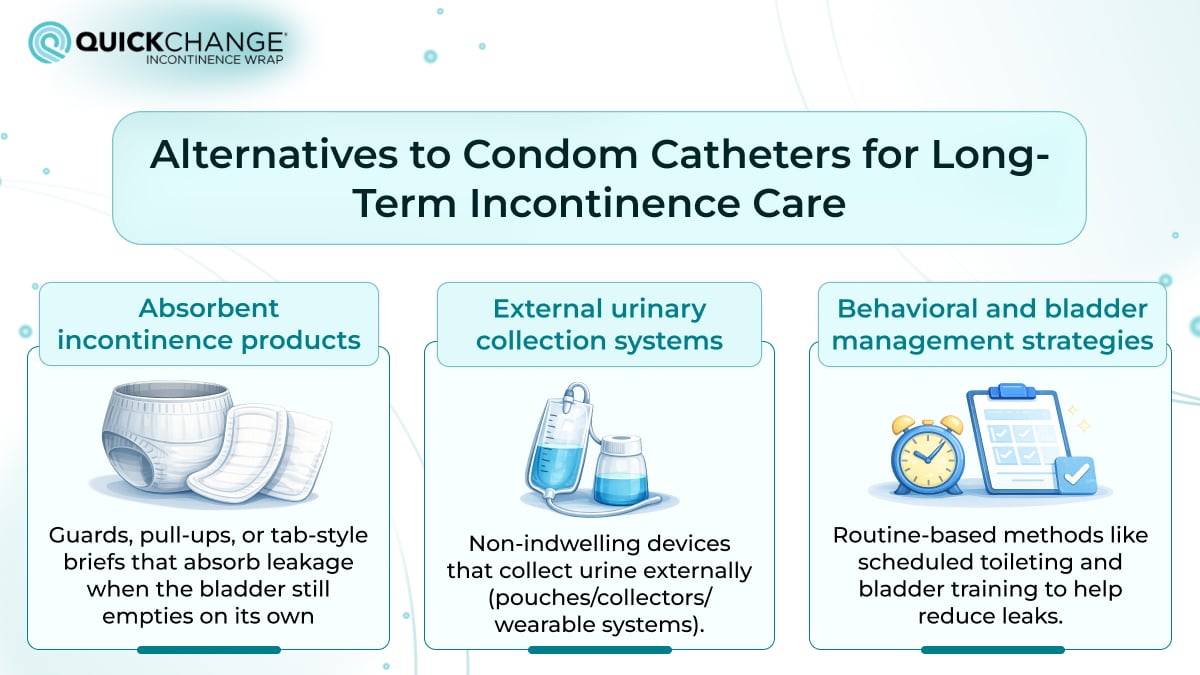
Catheters are widely applied to treat urinary incontinence, but they are not the only option. In the majority of cases, urinary incontinence can be managed with less invasive procedures that can be employed to relieve pain and simplify daily care. That is why people are inclined to start searching for alternatives to catheters, especially when the usage of a catheter system on a regular basis leads to issues. The contemporary management of incontinence is usually a combination of different techniques, including absorbent products, behavioral techniques, and external urine collection systems.
Wrap-Style Absorbent Solutions
Wrap-style absorbent solutions are often chosen in care settings where quick, low-effort changes matter. Instead of stepping into protective underwear, the wrap design allows the product to be positioned and secured more directly, which can be helpful when assisting someone in bed or in a chair. The focus here is not mobility, but controlled, comfortable leakage management in structured daily care routines. In long-term support environments, this format can simplify the workflow without relying on tubing or drainage systems.

Absorbent Incontinence Products
One of the most common alternatives to catheters is absorbent incontinence products, particularly when urine leakage occurs, but the bladder still empties on its own. These products include:
-
Incontinence pads: Thin absorbent pads that are placed inside regular underwear. They are often used for light to moderate incontinence and can provide extra protection throughout the day.
-
Guards for men: Men-specific pads, which are anatomically shaped and designed to prevent urine leakage in the front of the underwear.
-
Pull-up protective underwear: Absorbent underwear that fits like regular underwear and provides protection against leaks. This option is often used by people who remain mobile and want a more natural way to manage incontinence.
-
Tab-style adult briefs: Brief-style products that have adjustable side fasteners that can be changed more easily during care. They are usually applied to individuals who have low mobility or need the help of a caregiver, such as in a home care or long-term care facility.
The modern absorbent materials are able to absorb a lot of liquid and minimize the contact of the skin with the moisture. Superabsorbent polymers are also found in many products, converting liquid into a gel, aiding in odor control. Absorbent underwear or pads can be an effective alternative to catheter bag systems in daily life, where drainage tubing and collection bags may feel inconvenient.
External Urinary Collection Systems
For those looking for alternatives to condom catheters, external urine collection systems may be considered. Unlike indwelling catheters, they are not inserted into the bladder and instead collect urine externally. This category may include:
-
Adhesive urine collection pouches: Small external pouches that are secured to the skin with adhesive tape and collect urine without the use of tubes or an internal catheter. Such systems are sometimes used for short-term leakage control.
-
Male external collectors: External devices designed to channel urine into a drainage system without full adhesive attachment around the penis. Depending on their design, they may offer a different fit or application method compared to traditional condom catheters.
-
Wearable urine collection devices: Portable urine collection systems that can be attached to the body or clothing. Some models are designed for people with limited mobility or for use while sleeping.
Such systems are sometimes used by people with limited mobility or during sleep, when managing leakage can be more difficult. Their effectiveness depends on proper sizing, as an incorrect fit may lead to leakage. Skin condition and tolerance to adhesive materials also play a role in comfort and reducing irritation. In addition, proper positioning of the collection system is important for maintaining a secure fit and reliable urine drainage. For this reason, their practicality often depends on the individual situation and care needs.
Intermittent Catheterization
Intermittent catheterization is a method in which a catheter is used only for temporary bladder emptying and is then immediately removed. Unlike an indwelling catheter, the catheter does not remain in the body permanently. This approach is often used in cases of:
-
Neurogenic bladder: A condition where nerve damage affects bladder function.
-
Impaired bladder emptying: Difficulty fully emptying the bladder during urination.
-
Certain neurological conditions: Disorders that interfere with bladder nerve signaling.
For some patients, this approach may serve as an alternative to a permanent catheter, as it reduces the amount of time a catheter remains in contact with the urinary tract. However, intermittent catheterization requires proper training in technique to reduce the risk of injury or infection. It must also be performed consistently as recommended, using clean or sterile methods to minimise infection risk.
That is why this method is not suitable for all patients and usually requires prior training and regular performance of the procedure.
Behavioral and Bladder Management Strategies
In some cases, urinary incontinence can be partially managed through behavioral strategies designed to improve bladder control. These methods include:
-
Scheduled toileting: using the restroom according to a set schedule.
-
Bladder training: gradually increasing the intervals between urination.
-
Pelvic floor exercises: exercises to strengthen the pelvic floor muscles.
These approaches are often used in combination with other care methods and can help reduce the frequency of leakage episodes. For some people, these strategies become part of a comprehensive approach to managing incontinence and may be considered an alternative to a catheter in cases where symptoms are not severe.
Choosing the Right Alternative to a Catheter
When choosing an alternative to a catheter, it is important to consider how urinary leakage occurs and how continence care will be managed in practice. There are those solutions that absorb leakage and those that collect urine outside. The decision can also be based on the frequency of products that have to be replaced, the necessity of caregiver support, and the ease with which the solution can be integrated into the routine hygiene and skin care practices.
In other cases, conventional catheter systems may pose extra problems in day-to-day care. Drainage bags, connecting tubing, and the necessity of frequent monitoring of the system may be inconvenient, particularly to individuals with limited mobility or who depend on a caregiver. This is the reason why practical continence solutions are occasionally thought of, especially absorbent wrap-style continence products, which enable the management of urine leakage without the catheter system.
A practical option for men’s continence care is the QuickChange Wrap, an absorbent wrap-style product designed to support care in seated or reclined positions. Its construction is intended to simplify and speed up changes, which can be particularly helpful for individuals with limited mobility or those who require caregiver assistance. Thanks to a combination of absorbent materials and a comfortable design, the product helps manage urine leakage and maintain comfort during daily care. Key features of QuickChange Wrap include:
-
No tubes or drainage bags: QuickChange does not require drainage bags or tubes, unlike many catheter systems;
-
Wrap-style design for faster changes: The wrap-around design allows for quick changes without complicated procedures, which can be particularly important when caring for bedridden patients;
-
Reduced skin exposure to moisture: Absorbent materials help reduce skin contact with moisture and keep the skin dry;
-
Non-invasive solution: No device needs to be inserted into the body, making this a practical option for managing urinary leakage in some situations.
QuickChange Wrap is not a medical catheter replacement, but it may help manage urinary leakage in situations where absorbent continence care is appropriate. Learn more about how QuickChange Wrap works, including available trial and professional sample packs for caregivers and healthcare professionals.
When a Catheter May Still Be Necessary
Although there are many alternatives to catheters for managing urinary incontinence, in some medical situations, the use of a catheter may still be necessary. Catheterization can be used as a temporary or clinically justified solution when the body cannot empty the bladder normally on its own or when medical monitoring of urination is required. For example, a catheter may be necessary in the following cases:
-
Urinary retention: when the bladder cannot empty on its own;
-
Recovery after surgery: After certain surgical procedures, a catheter may be used temporarily to control urine flow and monitor the patient's condition;
-
Severe neurological conditions: in certain neurological disorders that affect bladder control.
In such situations, a condom catheter can be an important part of medical care. Therefore, the decision to use a catheter or to seek an alternative to a urinary catheter should always be made based on the clinical situation. Decisions regarding catheter use should always be made in consultation with a healthcare professional.
Conclusion
There are many alternatives to catheters that can be used to manage urinary incontinence in daily life. The selection of a suitable alternative to a urinary catheter is often based on medical considerations, the mobility of the individual, and the care environment. In most instances, less invasive methods, including absorbent products or external urine collection devices, help control leakage without necessarily using catheter systems.
Among absorbent options, the QuickChange Wrap may be a viable option in daily care because it is a product that can be easily and conveniently replaced. These solutions may be used to ensure comfort, ease of care, and act as an alternative to catheters in cases where absorbent products are suitable.
FAQ
What can I use instead of a catheter?
Common catheter alternatives include absorbent continence products such as pads, guards, or protective underwear, as well as external urinary collection devices. In other instances, toileting or bladder management plans can also be used to minimize leakage.
Are there alternatives to Foley catheters?
Intermittent catheterisation, external urine collection systems, or absorbent continence products may be used instead of a long-term indwelling Foley catheter, depending on the medical need.
What is the alternative to self-catheterization?
If the bladder empties without retention, absorbent continence products or external urine collection devices may be used instead of self-catheterization. However, when the bladder cannot empty properly, catheterisation may still be required.
Can incontinence be managed without a catheter?
Yes. Many people manage urinary leakage using absorbent products, scheduled toileting, or behavioural bladder strategies. Catheter use is typically reserved for situations involving retention or medical monitoring.
Is there an alternative to a catheter during surgery?
In most surgical procedures, temporary catheterisation is used to monitor urine output. In selected short procedures, bladder scanning or intermittent catheterisation may be considered, depending on clinical judgement.
This content is for informational purposes only and is not intended as a substitute for professional medical advice, diagnosis, or treatment. Always seek the advice of your GP or other qualified health provider with any questions you may have regarding a medical condition. Never disregard professional medical advice or delay seeking it because of something you have read or seen here.