Urinary catheters are commonly discussed in the context of the risk of urinary tract infection. However, in some care situations, the concern may extend beyond urinary symptoms alone, especially when catheter use, infection risk, and antibiotic exposure occur close together.
At the same time, UTIs and C. diff can occur simultaneously, complicating symptom assessment and daily care. In this article, we’ll look at how urinary catheters, UTIs, antibiotic treatment, and C. diff risk may be connected, and which symptoms may require closer attention.
What is C. diff, and How Does It Usually Appear?
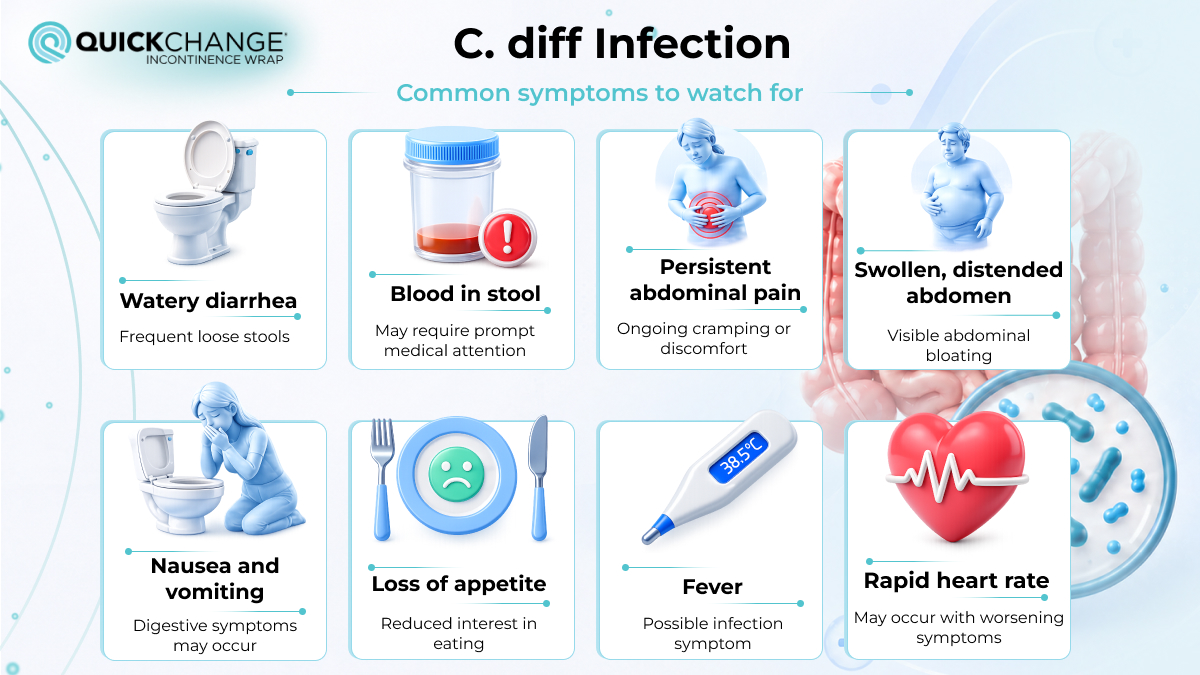
Clostridioides difficile, commonly known as C. diff, is a bacterium that can cause an infection of the large intestine. It most often develops during antibiotic treatment or shortly after a course of antibiotics, when the normal balance of bacteria in the gut is disrupted, and C. diff can multiply more easily. Common signs may include:
- Frequent watery diarrhea;
- Abdominal pain or cramping;
- Fever;
- Nausea.
C. diff is not an infection of the bladder or urinary system. However, antibiotics used to treat a UTI can increase the risk of developing C. diff in some patients, especially when other risk factors are present.
How Are Catheters Related to C. diff?
Urinary catheters do not cause C. diff on their own. However, they can be part of a chain of factors that increase the risk of this infection. Long-term catheter use increases the likelihood of a catheter-associated urinary tract infection, and if antibiotics are needed to treat such a UTI, it can create conditions for C. diff to develop in more vulnerable patients. The connection usually works through several steps:
- Long-term indwelling catheter use can increase the risk of CAUTI;
- CAUTI may require antibiotic treatment;
- Antibiotics can disrupt the normal gut microbiome;
- Disruption may allow C. diff to multiply more easily in vulnerable patients.
Catheter-Associated UTI and Indwelling Catheters
Catheter-related risk is usually most relevant with indwelling urinary catheters, which stay inserted and drain urine into a collection bag. Intermittent and external catheters may have different risk profiles, so they should not be grouped together with long-term indwelling catheter use.
This distinction matters because CAUTI risk is closely tied to how long a urinary catheter remains in place. The CDC explains that catheter-associated UTI can occur when germs enter the urinary tract through a catheter, and identifies prolonged catheter use as the most important risk factor for CAUTI. If this type of infection develops and requires antibiotics, that treatment can create a potential link to C. diff.
Antibiotic Treatment for UTI and C. diff Risk
Antibiotic treatment for UTI is not automatically a problem, especially when infection is confirmed, and treatment is clinically necessary. The concern is that CDI risk can vary depending on the medication, treatment duration, and the patient’s health history. Key factors may include:
- Antibiotic selection and treatment duration;
- Previous or repeated antibiotic use;
- Hospitalization or time spent in long-term care settings;
- Prior C. diff infection;
- The patient’s overall health and comorbidities.
Together, these factors help explain why the connection between catheters and C. diff is usually indirect.
Can UTI and C. diff Happen at the Same Time?
In some patients, urinary symptoms and gastrointestinal symptoms can appear close together, even when they do not come from the same cause. When new gastrointestinal symptoms appear during or shortly after treatment, they may need to be assessed separately from urinary symptoms.
In hospitalized patients, the elderly, or individuals with multiple comorbidities, this situation may be more difficult to assess. For example, fever can accompany both a urinary tract infection and C. diff, whereas abdominal pain, diarrhea, urinary discomfort, or changes in urination require separate evaluation. For this reason, new gastrointestinal symptoms during UTI treatment should not be folded into the UTI diagnosis without separate evaluation.
Does C. diff Cause UTI or affect the Bladder?
C. diff is an infection of the large intestine, not the bladder or urinary tract. For that reason, it does not directly cause a typical UTI, and the connection between C. diff and urinary tract infection should not be understood as the bacteria spreading from the colon into the bladder. The PubMed study in Open Forum Infectious Diseases examined infections that occurred after C. diff infection and found that people with CDI had a higher 90-day risk of UTI than those without CDI. This finding is better understood as a sign that some patients may remain more vulnerable to additional infections after CDI, especially when other risk factors are present.
Patients who have recently had CDI may still need closer attention to new urinary symptoms, especially if they also have recent healthcare exposure, catheter use, antibiotic treatment, or other risk factors.
Why Catheter Users May Need Closer Monitoring
Closer monitoring may be helpful when a patient with prolonged catheter use develops a UTI that requires antibiotic treatment. In such situations, the risk of a urinary tract infection is compounded by an increased concern about possible C. diff. Patients with overlapping risks may require special attention, including:
- Elderly people;
- Patients who have recently been hospitalized or stayed in a nursing home;
- People with a previous episode of C. diff;
- Patients with a weakened immune system;
- Those who have recently taken or are currently taking antibiotics.
In such cases, new gastrointestinal symptoms that occur during or after treatment for a UTI should not automatically be dismissed as a normal reaction to antibiotics. If diarrhea, abdominal pain, fever, or other atypical symptoms develop, they should be evaluated separately from the symptoms of the urinary tract infection.
In patients who use catheters or have a higher risk of infection, daily care can become more demanding when urinary leakage is also present. In these situations, caregivers may need to manage moisture, hygiene, product changes, and repositioning while also watching for new urinary or gastrointestinal symptoms.
Practical absorbent solutions can help reduce some of that workload when they fit the patient’s needs. For men with urinary leakage, QuickChange Wrap may be a practical addition to consider because it is applied around the penis and can be changed without a full brief change or extensive repositioning. For personal or caregiver use, a trial pack can help determine whether it fits the care routine, while professional sample options are available for healthcare teams and care facilities that want to evaluate it in care settings.

Symptoms That Should Not Be Overlooked
Since UTIs and C. diff are distinct infectious conditions, it is important not to confuse their presentations, even if they occur within a short period of time. While some symptoms, such as fever, may overlap, urinary changes and gastrointestinal symptoms typically point to different directions for clinical evaluation.
|
Possible signs of UTI |
Possible signs of C. diff |
|
Fever or chills |
Frequent watery diarrhea |
|
Pelvic or lower abdominal discomfort |
Abdominal pain or cramping |
|
Burning or pain with urination, when applicable |
Fever |
|
New urgency or frequency after catheter removal |
Nausea or loss of appetite |
|
Changes that require clinical assessment in catheter users |
Symptoms appearing during or soon after antibiotic treatment |
New or worsening diarrhea during or after antibiotic treatment for a UTI should not automatically be dismissed as a minor side effect, especially if it is accompanied by abdominal pain, fever, or other signs of possible C. diff.
Reducing the Risk: Catheter Use, UTI Prevention, and Antibiotic Awareness
When a catheter-related UTI requires antibiotics, risk reduction is not about avoiding necessary care. Catheters and antibiotic treatment may both be medically necessary, but careful catheter use, proper maintenance, and attention to new bowel symptoms can help reduce avoidable complications. The basic principles include:
- Avoid unnecessary catheter use by limiting catheterization to clear clinical indications;
- Remove catheters as soon as they are no longer needed, since longer use increases the risk of catheter-associated UTI;
- Follow proper catheter insertion and maintenance practices to reduce avoidable infection risks;
- Use antibiotics only when clinically necessary and consider their CDI-related risk in context;
- Monitor for bowel symptoms during or after antibiotic treatment, especially new diarrhea, which should be discussed with a healthcare professional rather than dismissed automatically.
These steps cannot remove every risk, but they can reduce avoidable complications and help caregivers notice symptoms that may need separate clinical evaluation.
Conclusion
Urinary catheters are not a direct cause of C. diff, but they can be part of a broader chain of risk factors. Prolonged catheter use increases the likelihood of a UTI, and if such an infection requires antibiotics, this can create additional conditions for the development of CDI in some patients.
UTIs and C. diff can occur simultaneously, and following a history of CDI, the risk of urinary tract infection may also be higher in certain patient groups. Therefore, new urinary or gastrointestinal symptoms should be evaluated separately rather than assumed to be an expected part of a single condition. If a man experiences urinary leakage while receiving medical care, solutions for faster and less burdensome changes, such as the QuickChange Wrap, can help simplify the daily care routine without unnecessary repositioning.
FAQ
Can C. diff cause UTI?
Not directly. C. diff primarily affects the colon, not the urinary tract. However, research suggests that people who have had CDI may face a higher risk of developing UTI in the following months, especially in healthcare-related contexts.
Can antibiotics for UTI lead to C. diff?
Antibiotics used to treat UTI can increase the risk of C. diff in some patients because they may disrupt the normal balance of bacteria in the gut. The risk depends on the antibiotic used, the patient’s health status, recent healthcare exposure, and whether they have had C. diff before.
Which urinary catheters are most relevant to UTI and C. diff risk?
The risk is most relevant with indwelling urinary catheters, especially when they remain in place for longer periods. Intermittent and external catheters may have different risk profiles, so they should not be grouped with long-term indwelling catheter use.
Can C. diff affect the bladder?
C. diff is not a bladder infection. It affects the large intestine. Still, severe illness, dehydration, hospitalization, or overlapping infections can complicate how urinary symptoms are interpreted, so new bladder-related symptoms should be assessed separately.
This content is for informational purposes only and is not intended as a substitute for professional medical advice, diagnosis, or treatment. Always seek the advice of your GP or other qualified health provider with any questions you may have regarding a medical condition. Never disregard professional medical advice or delay seeking it because of something you have read or seen here.